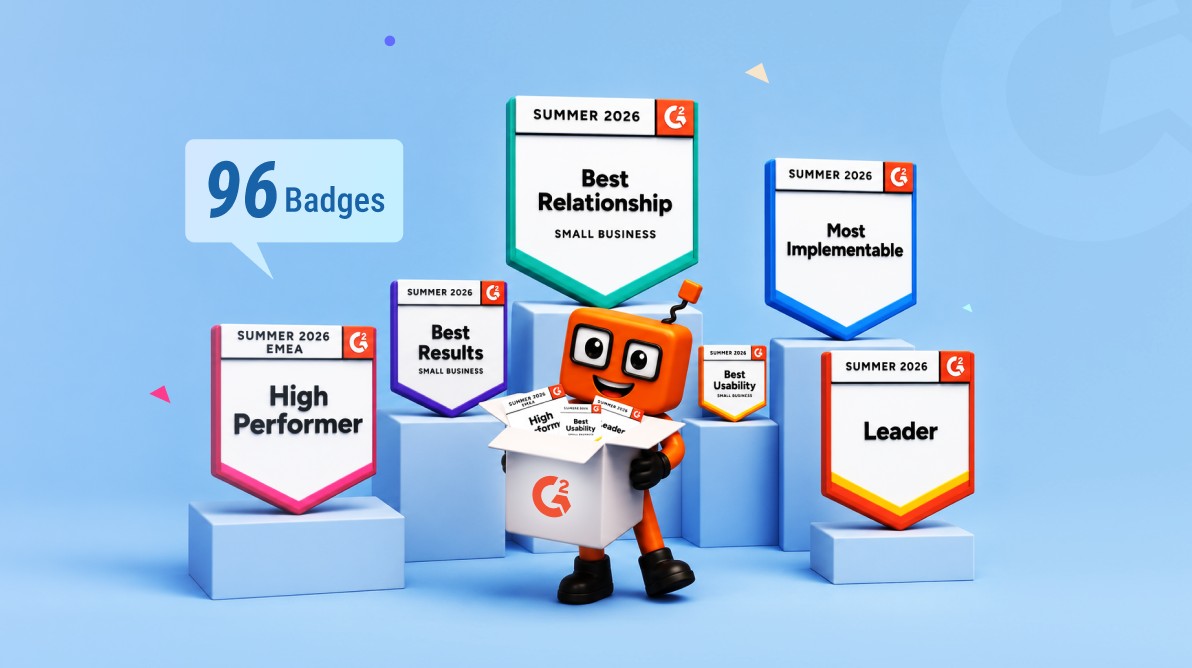
TL;DR: Syncfusion celebrates earning 96 G2 badges in Summer 2026 across key areas like UI components, frameworks, and document processing, driven by strong developer feedback and real-world performance. A big thank you to our developer community for your continued trust and support!
Awards can be impressive.
But in software development, awards only matter when they reflect something deeper than marketing recognition.
They matter when they represent how tools perform in real projects, under real engineering constraints, with teams working against deadlines, scaling products, solving performance bottlenecks, and maintaining applications long after launch.
That is exactly why G2 recognition matters.
Unlike traditional awards programs, G2 rankings come directly from user feedback, developers, engineering teams, architects, and businesses actively using products in production environments.
In Summer 2026, Syncfusion® earned 96 G2 badges, based entirely on customer feedback across multiple development categories.
But what makes this more interesting is not the number itself. It is the consistency.
- 98 badges in Winter 2026
- 93 badges in Spring 2026
- 96 badges in Summer 2026
When developers continue rating a platform highly quarter after quarter, it usually points to something more meaningful than product popularity.
It suggests teams continue finding long-term value after adoption. So rather than simply celebrating the badge count, it is worth asking a more interesting question.
Why do developers keep choosing Syncfusion repeatedly?
Let’s look at what these 96 badges actually represent.
What 96 G2 badges really represent
Awards alone rarely tell the full story. The more useful signal comes from understanding where that recognition is happening.
The Summer 2026 G2 badges span categories developers work with almost every day while building apps.
Recognition spans areas such as:
JavaScript and web frameworks
.NET Integrated Development Environment (IDE)
Component libraries
Data visualization libraries
Documentation generation
 |
 |
Integrated development environments (IDEs)
 |
 |
Mobile development frameworks
Web frameworks
 |
 |
But the real takeaway is not simply that Syncfusion earned badges across many categories.
The more important observation is this:
Developers continue rating these tools positively even after using them in production environments.
That usually indicates something stronger than feature depth. It reflects long-term developer trust.
Reducing repetitive development work across multiple platforms
One challenge many development teams face is repeated engineering work.
A team might be maintaining:
- Web applications in React.
- Internal enterprise apps in Blazor.
- Mobile apps in Flutter or .NET MAUI.
- Legacy desktop applications in WPF or WinForms.
And every platform often forces teams to rebuild the same foundational UI repeatedly.
- Tables
- Charts
- Data grids
- Forms
- Calendars
- Editors
- Navigation systems
This repeated work quietly slows development teams over time.
A unified component suite helps reduce that friction significantly.
Instead of repeatedly building foundational UI layers from scratch, developers can focus more energy on solving actual business problems. This becomes especially valuable for teams maintaining multiple apps across different technology stacks.
The less time spent rebuilding common UI patterns, the faster teams can ship production-ready apps. That reduction in unnecessary engineering work is one reason developers consistently value platforms like Syncfusion Essential Studio.
Document workflows often become more complicated than expected
Document processing looks simple on paper until applications start depending on it heavily.
Consider the scope:
- Generating PDFs.
- Editing Word documents.
- Creating spreadsheets.
- Embedding document viewers.
- Handling document approvals.
- Managing annotations and digital workflows.
Many teams eventually discover that document workflows introduce far more engineering overhead than expected.
Without integrated tooling, developers often end up stitching together multiple third-party APIs, external document services, custom converters, and isolated SDKs. That complexity grows quickly.
Imagine building an internal compliance platform. A typical workflow may involve:
- Generating reports as PDF documents.
- Reviewing and annotating documents.
- Updating spreadsheet-based data.
- Editing Word-based templates.
- Managing approval workflows within the same application.
Without an integrated document processing stack, developers are often forced to maintain several disconnected services.
Integrated SDKs simplify this significantly. Instead of wiring together separate external tools, developers can keep document workflows inside their own app architecture. That often leads to faster development cycles and lower maintenance overhead over time.
This is one reason developer reviews consistently recognize products like Syncfusion’s Document Processing SDKs.
AI becomes useful only when it reduces manual engineering work
AI is quickly becoming part of every modern development workflow. But developers can usually tell the difference between AI that genuinely helps and AI that simply feels bolted onto a product.
The most useful AI tools rarely succeed because they feel flashy. They succeed when they quietly remove repetitive engineering work.
Today, developers increasingly look for tools that help them:
- Generate working code faster.
- Reduce repetitive UI implementation work.
- Automate debugging workflows.
- Build interfaces using natural language prompts.
- Process documents using reliable SDK-backed operations.
- Reduce manual integration work between multiple tools.
The strongest AI integrations are often the ones developers stop thinking about because they naturally fit into the existing development workflow. This shift toward workflow-native AI is changing how teams evaluate development platforms.
That evolution continues to shape products like Syncfusion Code Studio and newer AI-assisted development tools across the Syncfusion ecosystem.
Choosing developer tools is a long-term decision
Most teams do not switch development platforms frequently.
Once a framework, component suite, or SDK becomes deeply integrated into production apps, replacing it becomes expensive. That means developers usually evaluate more than product features alone.
Questions often become broader. For example:
- How reliable is the documentation?
- How quickly can new developers onboard?
- Are there enough working examples?
- How responsive is support when production issues happen?
- Can teams upgrade safely without breaking applications?
- Will the platform scale with growing application complexity?
These long-term ecosystem questions often influence developer satisfaction more than feature comparisons. This is why developer reviews on platforms like G2 often reflect much deeper experience than first impressions.
In many cases, teams continue rating products highly because the overall development experience remains consistent even years after adoption.
Enterprise software eventually becomes about scale, security, and compliance
As apps grow, technical priorities begin shifting. Features become less important. Non-functional requirements begin taking over.
Development teams start focusing on:
- Security
- Compliance
- Accessibility
- Infrastructure reliability
- Long-term maintainability
- Production scalability
As products move into enterprise environments, these requirements become mandatory.
Platforms that already support standards such as:
- WCAG accessibility compliance.
- GDPR-focused security practices.
- SOC 2 Type 2 security standards.
- HIPAA readiness for healthcare workflows.
- High availability cloud infrastructure.
- Continuous security testing and monitoring.
…. allow engineering teams to move into production with fewer architectural blockers. These requirements rarely appear during early product evaluation but often become critical later.
That long-term stability frequently influences developer trust far more than individual product features.
Great developer platforms go beyond individual products
Good developer tools are rarely defined by a single component library. The broader ecosystem matters.
Teams move faster when they have access to:
- Reliable product documentation.
- Working code examples.
- Interactive demos.
- Upgrade guidance.
- Technical support resources.
- Developer learning materials.
- Community support channels.
- Frequent product updates and bug fixes.
Over time, these surrounding resources often influence productivity more than individual SDK features. This is another reason developer reviews tend to reflect long-term experience rather than short-term evaluation.
What these 96 G2 badges actually tell us
The badge count itself is not the most interesting part. What matters more is what repeated recognition signals over time.
When developers consistently rate a platform highly across multiple quarters, it usually means something important.
- It suggests teams can adopt the tools successfully.
- It suggests the products continue working reliably as apps scale.
- It suggests that the surrounding ecosystem, support, documentation, updates, and developer experience continue delivering value long after the initial evaluation process.
For us, these 96 G2 badges are not simply recognition. They represent feedback from developers building real products under real engineering constraints, and that kind of trust matters far more than awards themselves.
Closing thoughts
Software development tools are easy to evaluate during demos. The real test begins after adoption, when apps scale, deadlines tighten and teams need reliable tooling that continues working consistently across multiple projects and multiple years.
That is ultimately what G2 recognition helps reveal.
To every developer, architect, engineering team, and customer who continues trusting Syncfusion in production environments:
Thank you.
Your feedback continues shaping how we build tools that help developers ship faster, build better apps, and reduce unnecessary engineering complexity.
Want to explore what developers are building with Syncfusion?
Visit Syncfusion Product Demos, explore community feedback on G2 Reviews for Syncfusion, and see how development teams are using Syncfusion across web, desktop, mobile, document processing, and AI-powered development workflows.
Looking to explore more? Visit our YouTube channel, documentation, GitHub, and web demos to dive into our components and see what’s possible.
Already using Syncfusion? Download the latest setup from your license and downloads page. New here? Start a free 30-day trial and experience it firsthand.
Need support along the way? Reach out anytime through our support forum, support portal, or feedback portal. The Syncfusion team is always here to help you build faster, smarter, and with confidence.
PakarPBN
A Private Blog Network (PBN) is a collection of websites that are controlled by a single individual or organization and used primarily to build backlinks to a “money site” in order to influence its ranking in search engines such as Google. The core idea behind a PBN is based on the importance of backlinks in Google’s ranking algorithm. Since Google views backlinks as signals of authority and trust, some website owners attempt to artificially create these signals through a controlled network of sites.
In a typical PBN setup, the owner acquires expired or aged domains that already have existing authority, backlinks, and history. These domains are rebuilt with new content and hosted separately, often using different IP addresses, hosting providers, themes, and ownership details to make them appear unrelated. Within the content published on these sites, links are strategically placed that point to the main website the owner wants to rank higher. By doing this, the owner attempts to pass link equity (also known as “link juice”) from the PBN sites to the target website.
The purpose of a PBN is to give the impression that the target website is naturally earning links from multiple independent sources. If done effectively, this can temporarily improve keyword rankings, increase organic visibility, and drive more traffic from search results.